
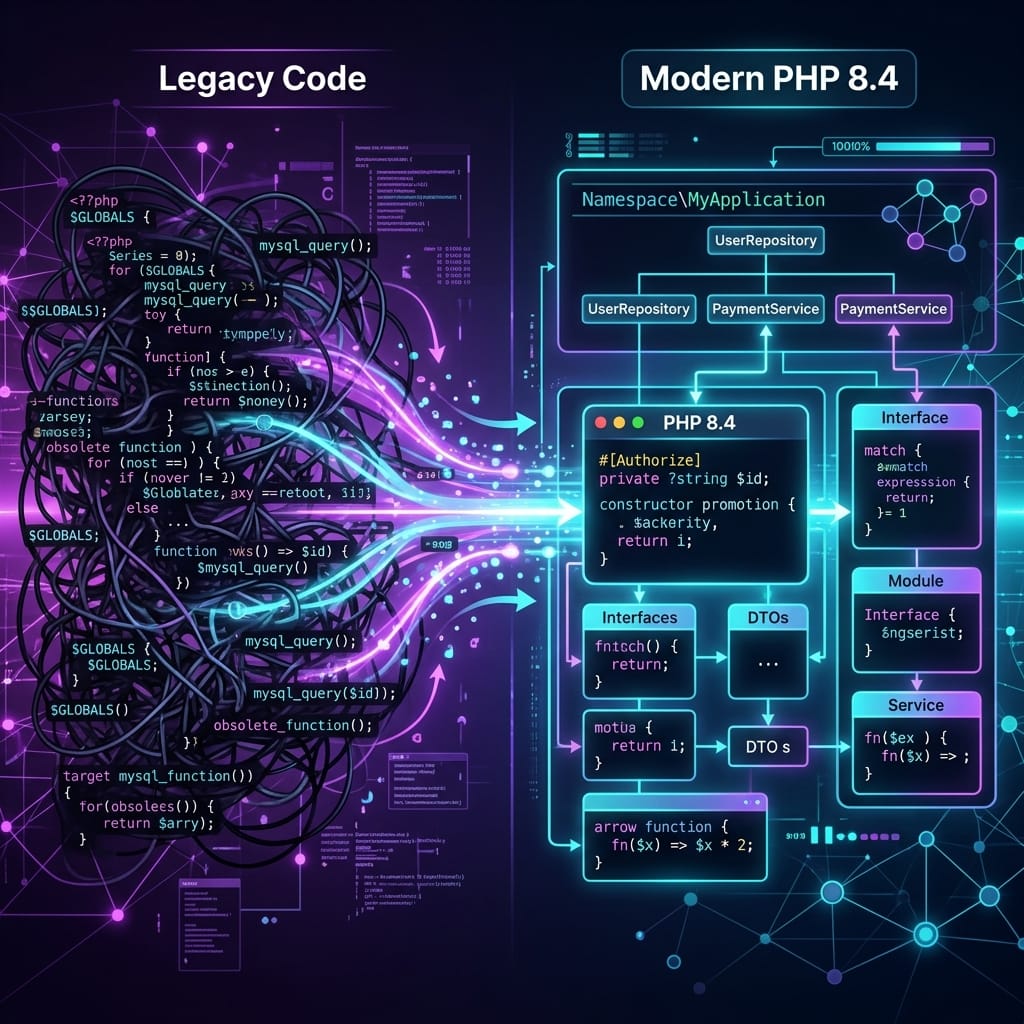
Modernizing Legacy PHP Apps: A 2026 Refactoring Guide
PHP is Dead? Long Live PHP!
The rumors of PHP’s demise have been greatly exaggerated. In 2026, PHP remains the backbone of the web, powering over 70% of all active websites. With the release of PHP 8.4, the language is faster, stricter, and more robust than ever.
However, millions of legacy codebases are still struggling with outdated patterns. Here is how to bring your legacy PHP app into the modern era.
Step 1: Embrace Strict Typing
Modern PHP is strongly typed. Begin your refactoring journey by enabling strict types at the top of every file: declare(strict_types=1);. Then, methodically add scalar type hints and return types to your functions. This single step will catch countless hidden bugs in legacy code.
Step 2: Ditch the Globals
If your application relies heavily on $_SESSION, global $db;, or massive configuration arrays, it’s time to implement a Dependency Injection (DI) container. Tools like PHP-DI or Laravel’s Service Container allow you to decouple your classes and make them infinitely more testable.
Step 3: Leverage Modern Language Features
- Constructor Property Promotion: Stop writing tedious boilerplate for your DTOs.
- Match Expressions: Replace convoluted
switchstatements with clean, exact-match syntax. - Readonly Classes: Ensure absolute immutability for your value objects.
Refactoring legacy PHP is a marathon, not a sprint. Take it one file at a time, rely on static analysis tools like PHPStan, and watch your application’s performance soar.
editor's pick
latest video

news via inbox
Nulla turp dis cursus. Integer liberos euismod pretium faucibua